


THE COUNTRY
Central Africa
ABOUT THE ANIMAL
Common Name: Aubry’s Flapshell Turtle
Scientific Name: Cycloderma aubryi
ABOUT THE AUBRY'S FLAPSHELL TURTLE
The Aubry’s Flapshell Turtle (Cycloderma aubryi) is one of Africa’s least-studied freshwater turtles. Found in the rivers and wetlands of Central Africa, this unique softshell turtle spends much of its life hidden beneath the water or buried in soft mud, making it difficult to study in the wild.
Although Cycloderma aubryi is currently classified as Vulnerable by the IUCN, increasing concern over declining wild populations and the numerous threats facing the species suggest that it may warrant reassessment as Endangered in the near future. Across much of its range, freshwater turtles are heavily harvested for bushmeat, where they provide an important source of protein for local communities. Softshell turtles are especially sought after, and illegal collection for both local consumption and the international wildlife trade continue to place pressure on wild populations.
Rather than waiting until this species reaches the brink of extinction, Turtle Island believes in acting early. By establishing healthy assurance populations before numbers collapse, we have a much greater chance of protecting species for future generations.
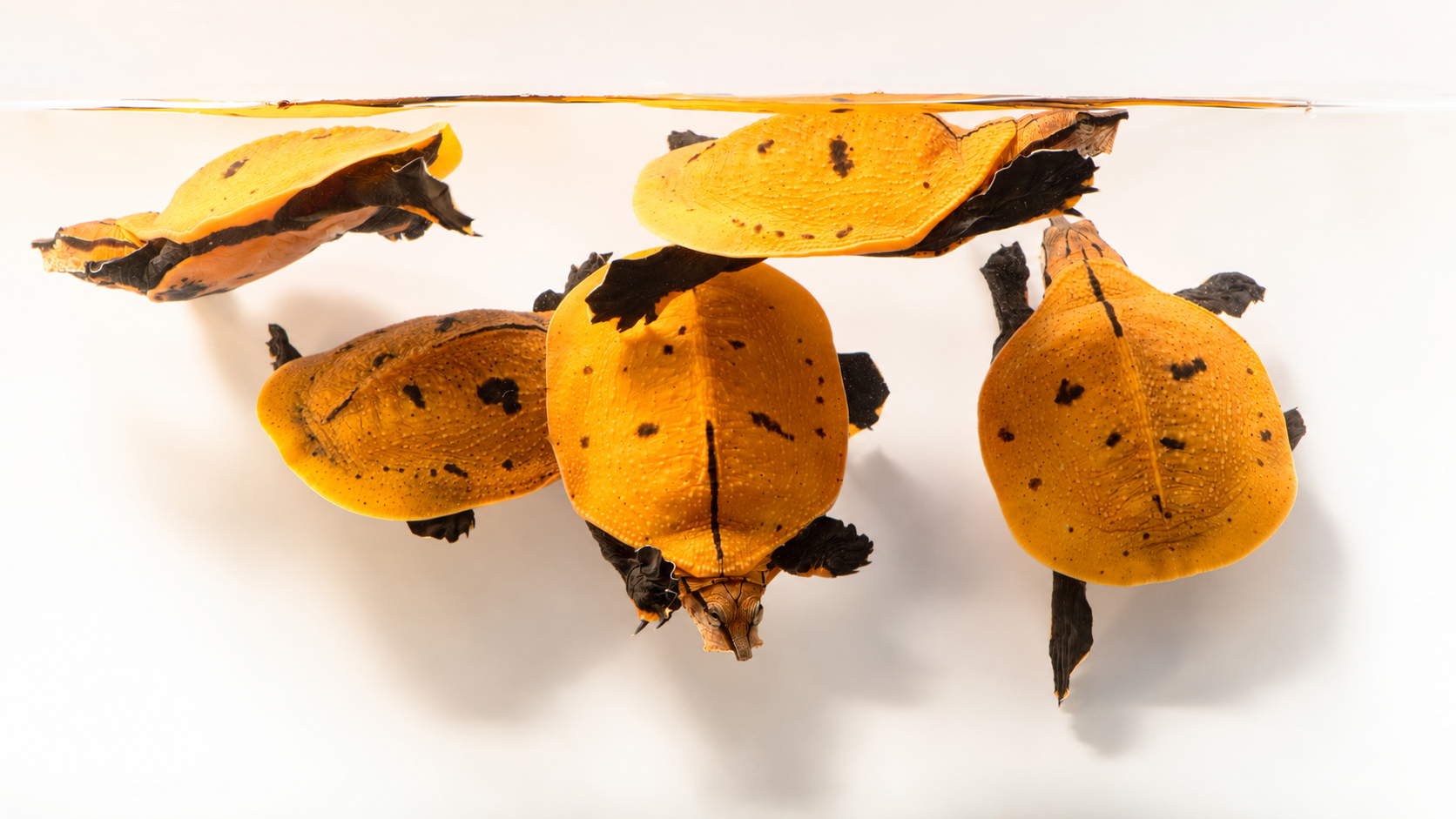
The unique, enlarged lips give these bizarre turtles a distinctive appearance resembling a vacuum cleaner. In fact, these camouflaged ambush feeders specialize in waiting motionless for unsuspecting fish to approach before striking with remarkable speed. Hatchlings are remarkably colorful, with striking red carapaces and heads contrasted by black feet. Despite their vivid coloration, they are perfectly camouflaged in the shallow water among fallen leaves beneath the rainforest canopy. When small fish draw near, the hatchlings rhythmically move their front legs, creating a gentle current that draws water toward their heads.
Despite their large size, Aubry’s Flapshell Turtles are gentle, curious animals that are remarkably calm and easy to work with in human care. Yet very little is known about their biology, ecology, or genetic diversity. Scientists have not yet conducted comprehensive genetic studies across their range, and it is possible that multiple distinct lineages or even undescribed taxa exist. Understanding this diversity will be critical for guiding future conservation efforts.
AUDRY'S EXTRAORDINARY STORY
Audry changed the future of her species.
Turtle Island inherited Audry after her owner, Hynek Prokop died and it quickly became clear that she was suffering from a severe bacterial infection that via a CT scan could be seen spreading deep into her shell. Without intervention, the infection would almost certainly have been fatal.
Saving Audry required an unprecedented surgical procedure. Turtle Island’s founder and veterinarian, Dr. Shannon DiRuzzo, carefully removed large sections of her shell using a bone saw before treating the infected tissue with a medical laser. The operation carried enormous risks, and many believed it would be impossible for such a large softshell turtle to survive. Through Dr. DiRuzzo’s expertise, exceptional surgical skill, innovative approach, and months of dedicated care during Audry’s recovery, she survived the surgery and went on to make a full recovery.
Two years later in 2021, she achieved another milestone.
Fully healed and thriving, Audry became the first Aubry’s Flapshell Turtle ever to produce viable eggs in captivity. Successfully breeding this species required every aspect of her care to be perfected, from restoring her health after surgery to recreating the same environmental conditions of her native habitat, while also pairing her with a compatible male.
The eggs were carefully incubated, and approximately two months later they hatched. These hatchlings represented the world’s first successful captive breeding of the species, a milestone that provides new hope for the long-term conservation of the Aubry’s Flapshell Turtle.
Today, Audry weighs nearly 14 kilograms (31 lbs.) and is the largest Aubry’s Flapshell Turtle ever encountered by Turtle Island’s Founder, Peter Praschag. Her extraordinary journey, from life-threatening illness to becoming the first successful mother of her species in captivity, represents a major milestone for the conservation of the Aubry’s Flapshell Turtle and demonstrates the impact of expert veterinary care and dedicated conservation breeding.
OUR CONSERVATION EFFORTS
Turtle Island is currently home to the world’s only known successful captive breeding program for the Aubry’s Flapshell Turtle.
Our founder animals did not come from the wild for the purpose of conservation. Instead, they arrived through rescue and rehoming efforts before the species became protected. Some were acquired from the ornamental fish trade, while others were surrendered by private keepers who could no longer care for them or inherited from collections after their owners passed away. By providing these turtles with expert care and a permanent home, Turtle Island has transformed rescued animals into one of the world’s most important conservation populations for the species.
Our work extends far beyond breeding. We continue to refine husbandry techniques, improve veterinary care, and document the species’ biology so that this knowledge can benefit future conservation programs around the world.
FUTURE PLANS
Our long-term goal is to establish a secure, genetically diverse assurance population while expanding scientific knowledge of this poorly understood species.
One of our highest research priorities is to better understand the genetic diversity of Aubry’s Flapshell Turtles across Central Africa. Comprehensive genetic studies may reveal previously unrecognized populations or distinct evolutionary lineages, helping conservationists better protect the species before additional diversity is lost.
As our breeding program continues to grow, we hope to collaborate with conservation partners to better understand the status of wild populations and support efforts to protect their freshwater habitats. By combining conservation breeding, scientific research, and international collaboration, Turtle Island aims to ensure that this remarkable species remains part of Africa’s rivers for generations to come.
HELP US PROTECT ENDANGERED TURTLES AND TORTOISES
This project is just one part of Turtle Island’s mission to protect endangered turtles and tortoises worldwide. You can stay connected with our work, whether it’s following for updates on Audry, the Aubry’s Flapshell Turtle breeding colony, or learning about our other ongoing turtle conservation projects by subscribing to our newsletter.